
 Posts
Posts


Lord: a sobriquet, a bunch of letters,
yet the supreme harmonious harmony
embracing the disturbed eardrums
and tintillating them into a universe
poured in by melodies of a thousand music,
the mysterious euphony prayed for to hear.
Lord: a tiny word
yet holds the voluminous effect
that appease my heart
and awaken it to ever-soothing phenomenon
magnified by the gratifyingness and pureness
of that word; that captures
into a whole and overwhelming lightness
all my spirit.
Lord: the seekable unseeked by some seekers
the lovable unloved by some lovers
the teachable untaught by some teachers
the adorable unadored by some adorers
the praisable unpraised by some praisers
the seizable unseized by some seizers.
Lord: so peculiar yet so pleasant
this is the language I shall always enunciate
to understand the world and be understood.
LORD
Mary, The Mother of God
The Mother of the human race, the most blessed and revered Virgin Mary, was of the royal family of David. And a pious old legend tells us about her early days. Born in the city of Nazareth, her parents Joachim and Anne, were of Galilee and Bethlehem. He was a man of reputation, of modesty, and serenely submitted to the will of God. Anne was loved for her surpassing virtues, transcended dignity, and gracious kindliness. Their lives were simple, they had no children, yet they did not forget the word of God that from their eminent family should rise the Messiah promised to the nation.
A spiritual attribute acclaimed this family of the house of David. An ambiance of prayers, works of compassion surrounded them for they were trained with trust and hope. They promised that if God would favour them with a child, they would dedicate her to the service of the Lord.
On a certain day, the angel of the Lord, with a prodigious light appeared to Joachim and said: "Be not afraid, Joachim, nor troubled at the sight of me, for I am an angel sent by Him to inform you that your prayers are heard. If reason will not convince you of the truth of my words, and that those who were barren have brought forth to their great surprise; therefore Anne, your wife, shall bring you a daughter and you shall call her name, Mary.
She shall, according to your vow, be devoted to the Lord from her infancy, and be filled with the Holy Ghost from her mother's womb. She shall be in a manner miraculously born of one that was barren; and while yet a virgin, in a way unparalleled, bring forth the Son of the Most high God, who shall be called Jesus, the Saviour of all nations!"
And the angel of the Lord, in such a heavenly splendour, vanished. Consequently, the angel appeared to Anne saying: "Fear not, for I am that angel who hath offered up your prayers before God and am now sent to inform you that a daughter will be born to you, who shall be called Mary, and shall be blessed above all women.
She shall be, immediately upon her birth, full of the grace of the Lord. In a word, she shall serve the Lord in the temple, shall abstain from every unclean thing, and never know any man. And, being an unparalleled instance without any pollution or defilement and a virgin, shall bring forth a son, who both by His grace and name and works, shall be the Saviour of the world."
Both Joachim and Anne were instructed by the angel to go to the golden gate of Jerusalem. Made glad by each other's vision, they gave due thanks to the Lord who had promised them a child.
Anne, being herself a vessel of honor and goodness, brought forth an unstained soul which according to the angel's ordain was named Mary. As Mary approached the extremity of womanhood, she raised in mildness, worthiness, and charm shedding around her peace and happiness as flowers scatter sweet and refreshing aroma or as the multitude silvery rays of the moon shed its favorable stream of light to the world.
When she reached the age of three, Joachim and Anne dedicated her to the temple of the Lord in Jerusalem. How they loved the child, yet in their humble unpretentious, they felt themselves undeserving of possessing such a lovely being.
The journey was tiresome. They passed through muddy roads, across bumpy rocks and clusters of thorny bushes. The atmosphere though dominatedd by deep clouds, unvieled the temple, impressively brilliant with light. It was habitual to offer up a sacrifice and so they did. As Mary lifted the stairs of the temple, two hearts which once abounded in joyousness were plunged into sadness. Her absence alone was ample to give them pain. What a great trial God had given them, yet, they had obeyed.
Mary performed all sacred undertakings of a virgin consecrated to the service of the temple. She engrossed herself in ardent meditation, praises to the Lord and communicatuions with the angels from heaven.
In here fourteenth year, Mary was to leave the house of the Lord for marriage, which was a rigorous accountability amongst the Hebrews. To this order, all the other virgins yielded absolute compliance. Mary, the Virgin of the Lord, who lived in a permanent exaltation of prayer in the temple, explained to the high priest, in great sadden of heart that it was her wish never to leave the temple for she had pledged her virginity to the Lord. The high priest, then did not consent to Mary's wishes.
The Blessed Virgin pleaded God with extensive ardor and she prayed, a surprise hearten her and gave her vigor to agree to her marriage.
Since Mary's loveliness, delightfulness, and maidenly values had circled throughout the city, limitless suitors intensely longed for her as wife. Mary's parents no longer lived, so, the resolution was sought out by a prophecy of Isiah that "There come forth a rod out of the stem of Jesse and a flower shall spring out of its roots."
Among the suitors was a pious man named Joseph of the family of David. As he drew his rod, it bloomed and a dove from heaven settledown on it. everyone then knew that Joseph, the most honorable of all men, was destined by the Lord to be betrothed to the pristine maiden of Nazareth.
The nuptial ceremony being over, the new couple, under the leadership of the Most High, returned to Galilee. Mary, in here peaceful life prepared herself for the unfathomable work God had determined her.
On a certain day, when the pure and chaste Virgin was so preoccupied in one of her transports, the Angel Gabriel, more radiant than ever appeared in the ambient air, and said to her, "Hail, Mary! full of grace, the Lord is with thee, blessed art thou amongst women."
The Virgin seemed troubled at his sudden obeisance and began to cogitate what it meant. To this thought the angel replied, "Fear not, Mary, for thou hast found grace with God: Behold, thou shalt conceive in thy womb, and shall bring forth a son, and thou shalt call Him Jesus.
He shall be great, and shall be called the Son of the Most High, and the Lord God shall give unto Him the throne of David His father; and He shall reign in the House of Jacob forever, and of His kingdom, there shall be no end."
To this discourse of the Angel Gabriel, Mary remembered her vow of virginity. The angel replied, "Think not, Mary, that you shall conceive in the ordinary way. The Holy Ghost shall come upon thee, and the power of the Most High shall overshadow thee. And therefore, the Holy which shall be born of thee shall be called the Son of God."
And Mary answered, Behold the handmaid of the Lord, be it done unto me according to thy word."
What the divine messenger revealed, filled Mary's heart with inscrutable love and unbounded blissfulness. What was in her affectionate heart was for God alone. Joseph knew not of this, yet, he kept here in purity.
When the ninth month of the Virgin's conception drew near, they journeyed to Bethlehem. While they were there, Mary brought forth the divine Child, the only-begotten and substantial Son of God.
God’s Little Schemes
It was a day unlike the usual. We received a phone call saying that we passed the professional board exam! A day of good news for my Arl and me, I must say. But why was I feeling a bit edgy? You see, I was having a little problem just how exactly we will celebrate the day.
A couple of hours had passed and I was still wondering what to do when Arl’s best friend unexpectedly met and joined us in the mall. “I came to celebrate the day with you,” he said. Was I surprised? You bet I was! He was the answer to my hours of unproductive planning and imagining.
To make the story short, we dined together in a fine restaurant outside the mall, laughed over a funny movie we decided to watched, and spent the rest of the day talking while enjoying a plate of kikiam and squid balls. It was simple. Yet, it was great.
Oftentimes, we plan and think too much. We want things to be perfect. No hassle. No error. We want things and events in our lives just the way we imagine them.
There is a very big danger to thinking and planning too much. Without us knowing, this could become a habit. We can be trapped. If this happens, we will become persons who never get to action. We will become persons who are so obsessed with planning a celebration that at the end of the day we will realize that we have never celebrated at all.
Think about this: we are already given enough reasons to be happy, yet we still plan how to make happiness happy.
There is another way out of this controlling fear of being out-of-control. We can let God take control. His little schemes are far better than ours. And the only thing which God requires from us is our openness and acceptance. We should realize that it is not how perfect we plan and think. It is how God in that particular moment touches and changes us and how, as a result, we make other people share and enjoy His presence too.
God wants us not merely to be happy but to be happiest. He wants our joy to be complete. God, therefore, surprises us in many ways. He uses events, people, even the ways we so least expect. But are we always ‘in’ for God’s surprises? Are we present to enjoy His little schemes? Or are we too busy, too preoccupied to notice the little miracles that He sends our way?
I believe this is the part where we should think.
The Power of Seeing
Have you experienced looking for something and not finding it, only to realize later that you have been staring at it? Or have you experienced finding something you thought you will never find? Let me tell you a story.
I was half asleep one late evening when I heard my friend uttered a word of dismay. Awakened, I asked her what happened. A piece of her new sunglasses was lost she said. I saw her turned her bag inside out where she kept her sunglasses but found nothing. She looked on the table, then on the floor, but still did not find anything. I, wanting to help her, got out of bed, checked her sunglasses and found out that it was the screw she lost. With a flashlight in my hand, I started the search.
I rechecked my friend’s bag. I rechecked table. I looked diligently through every corner of the room. Yet there was nothing. My friend began to feel hopeless and told me that it is over. She wanted to terminate the search. But the desire to find the screw grew inside me. I became more eager. So I kept looking until suddenly, I heard a very light click on the floor. I knew it was the screw! I must have kicked it when I moved to the door. Slowly, I sat down to scan the floor. And behold! There was the screw lying on our doorstep – the tiny 4mm screw! Like a precious gem, I carefully picked up the screw and held it before my eyes. I was jubilant!
From the start, I had this strong feeling that I will find that screw as much as I believe that innate to every one of us is the determination and will to find what we have been searching for. I believe that if we want to find and if we believe we can find whatever it is we wanted to get, we will find it. It is the wanting, the desire, the drive, the perseverance that count, not the looking. There are no lazy eyes, only lazy minds.
God gave us two extraordinary gifts: the eyes and the power to see. What we are looking for, more often than not, is right in front of us, waiting to be found. Waiting for our attention. But the question is, “Do you want to see?” “Do you wish to find what you are looking for?” “Are the things you are looking for the things you really, truly want?” “Are you seeing what you are called to see or only the things you wanted to see?” “Do your eyes see beyond what you see?”
Like the two blind men who saw the light of Jesus in the dark (Matthew 9:27-31) and the man born blind who sees (John 9:1-40), we are able to see even the tiniest. This is a free gift, a unique power. Not [to want] to use this gift could be amountable to self-blasphemy.
THE PARABLE OF THE UNMERCIFUL SERVANT (MATTHEW 18:23-35)
The woe in the world ranging from small to wider relationships awfully disturbs me and oftentimes catches and leaves me off guard. I wish to be enlightened and to assist me is the Parable of the Unmerciful Servant (Matthew 18: 23-35).
In this study, I invite the reader to delve with me into the meaning conveyed by this parable about relationships and the [kind of] God that is being presented to us. With the aid of redaction criticism and the scholars’ viewpoint and commentaries, I shall go through Matthew’s editorial and literary works and purpose and try to present the parable as Jesus shaped it. From there I will dig deeper on the possible existing meaning of the parable that I hope would illumine what I want to bring to the fore. Lastly, I shall pose a challenge to be brought home, pondered and gave birth to.
THROCKMURTON(2)
< < < < < < < < < < < < < <> > MARK 9:50 – LUKE 9:50
< < < < < < <> > > > > >
< < < < < < < < < < < < < < <> > > > > > > > > > > > > > > > >
23[“Therefore] [the kingdom of heaven may be compared] to a king who wished to settle accounts with his servants. 24When he began the reckoning, one was brought to him who owed him ten thousand talents; 25and as he could not pay, his lord ordered him to be sold, with his wife and children and all that he had, and payment to be made. 26So the servant fell on his knees, imploring him, ‘Lord, have patience with me, and I will pay you everything.’ 27And out of pity for him the lord of that servant released him and forgave him the debt. 28But that same servant, as he went out, came upon one of his fellow servants who owed him a hundred denarii; and seizing him by the throat he said, ‘Pay what you owe.’ 29So his fellow servant fell down and besought him, ‘Have patience with me, and I will pay you.’ 30He refused and went and put him in prison till he should pay the debt. 31When his fellow servants saw what had taken place, they were greatly distressed, and they went and reported to their lord all that had taken place. 32Then his lord summoned him and said to him, ‘You wicked servant! I forgave you all that debt because you besought me; 33and should not you have had mercy on your fellow servant, as I had mercy on you?’ 34And in anger his lord delivered him to the jailers, till he should pay all his debt. 35[So also my heavenly Father will do to every one of you, if you do not forgive your brother from your heart.”]
The Parable of the Unmerciful Servant (18: 23-35), not traceable either from Mark or Luke, is a Matthean sondergut taken from the special material of Matthew in his tradition or community.(3) It is located at the close of Matthew’s community discourse (chapter 18), which is the fourth among Matthew’s gospel discourses. It is written right after Peter’s question about forgiveness (18:21-22) and before the beginning of the narrative on Authority and Invitation (19:1ff).
Verse 35 is parallel to 6:14-15 and appears to be Matthew’s conclusion to chapter 18. It gives a command, a rule or a law that Matthew leaves for his audience. I noticed Matthew’s use of formative words and expressions reflecting Semitic language and rabbinic usage like ‘Kingdom of heaven’ (v. 23) and ‘heavenly Father’ (v. 35) in the parable. The mention of “wife and children” (v. 25) to be sold with the servant and all his properties evokes in me an opposing reaction having reminded of patriarchy that treats children and women as male’s properties.
I observe the first and the second servants’ use of the same words in verses 26 & 29 as well as the huge difference between the two debts in verses 24 & 28. Furthermore, it is the action of the king towards the first servant (v. 27) and the first servant’s response to the second servant (v. 30) and the fate that befalls the former (v. 34) that catch my attention most. It seems to me that the emphasis moves from the king’s action to the first servant’s action and fate to the audience.
Commentators like Manson, Dodd and Crossan, encountered tension and difficulty on the connection between verses 21-22 and 23-35. Crossan for instance, sees the inconsistency of God’s action (v. 34) in the parable to the exhortation to forgive “seventy-seven times” in v. 22.(4) B. Viviano, in addition, sees the parable as loosely attached to the teaching about Genesis 4:15,24 and a homiletic midrash on Mathew’s instruction in 6: 12, 14-15.(5) Nevertheless, Herzog says that majority (i.e. Donahue, Oesterley, Fuchs, etc.) had less difficulty and easily recognized the complementarities of the two.(6) Matthew situated the parable in its present context and used the connective “Therefore” (v. 23) to place the parable and connect it to the preceding text. Matthew shifts the focus on forgiveness from its quantitative nature in verse 22 to a qualitative precondition, and at the same time, of the parable’s meaning by adding the introductory formula “the kingdom of heaven may be compared…” (v. 23), and verse 35 that reflects Matthew’s tendency to frame the parable in terms of law.(7)
With that, the parable must not be taken out of the context where Matthew placed and purposely intended it because it has a sound and potent tendency to condition and measure God’s forgiveness and contradict and nullify Jesus’ teaching in 18:21-22 and 5:44-5.(8) Matthew’s editorial comment (v. 35) is directed as a warning for his community. This clearly exhibits his primordial and pastoral concern about his community, who is vulnerable to painful division and factions and like a ‘ship beaten by waves’ (8:23-27).(9) Matthew is [known] as an ecclesial Gospel (16:18-19, 18:18, 20:20-21) and the Church officially claims it as such.(10)
At this point, allow me to treat the parable one step backward from Matthew’s editorial and literary works and purpose and look into how Jesus himself probably shaped the parable.
I take the position that the connective “Therefore” and the formulaic introduction “the Kingdom of heaven may be compared…” (v. 23), plus verse 35 are Matthew’s authorial works and additions to the original text. Yet, others opine that without them, the heart of the parable of Jesus can still be read and explored.(11) Crossan holds that the emphasis lies on the servant’s lack of mercy and stupidity of showing it (vv. 28, 30) rather than on the master’s mercy (v. 27) while Hare takes the latter.(12) Herzog, using the positions of Eta Linnemann and Jeremias as springboard, presents that the meaning of the parable can be examined from the point of the king’s action and verdict (vv. 27, 34) which emphasizes God’s forgiveness and the first servant’s shifting fates (27b, 34) which stresses human response and responsibility.(13)
I, on the other hand, closely following the perspectives that Crossan, Hare and Herzog put forward, would like to underscore two views in the context of relationship that I am trying to present. After understanding Matthew’s authorial works, the first major view, is the king’s action (v.27) toward the first servant because it generates an awesome atmosphere and response and foremost, it is a good point to open and ground my position that everything comes to us as a gift. Gift here means life wrapped in surprise freely given from the ‘Being’ of the Giver who from the beginning wants to unite and reunite us to Her/Himself, completely restore us and bring us wholeness. This is the premise that leads to a demanding question: how must we live by it? The diverse action of the first servant (v. 30), emphasized most by the huge difference of the two debts (vv. 24, 28) and the same words used in verses 26 and 29(14), evokes in us a violent response and condemnation as in v. 34. This is the crucial view but fittest to blow off the heart of Jesus’ parable. Before I proceed, let me pose a warning that I am not talking of allegory here.(15) We are deeply and enormously endowed with a gift but this does not mean power and superiority over the other. The gift must be received with open eyes and awareness, must make us humbler and change us to persons capable to effect restoration, healing and wholeness for others as well. The gift must move us to decide and act at the full service of life, freedom and the fulfillment of the gift itself. The parable shows us that consequences inevitably result from the decisions and actions we make.(16) Decisions and actions that, if done at the expense of freedom, [human] life, growth and becoming of every creation, are first and foremost self-destructive isolating us from the movement of life and the rest of all creation.
In summary, redaction criticism plus the scholars’ point of view helps me to read and understand the parable in two ways: as Matthean interpretation and as Jesus’ parable. I come face to face with Matthew’s important role as author of the parable who takes it from his special material and makes editorial works (“Therefore” “the kingdom of heaven may be compared…” v. 23) and concluding moral (v. 35) in order to place it in its present context (community discourse) and stress his pastoral concern (v. 35). I also tried to understand the parable as Jesus shaped it first by presenting three positions of different scholars on where the key to Jesus’ parable lies: a) the first servant’s lack of mercy and foolishness by showing it, b) the king’s mercy and c) the king’s action and the first servant’s shifting fates. Then, following similar fashion, I present the king’s action and the first servant’s opposing action and fall and ground it in the context of relationship highlighting our God-given-ness and the inevitability of result of the decision and action that we make.
I believe that The Parable of the Unmerciful Servant (18:23-35) is appropriate, exact and central to all our relationships – with God, other, creation, and ourselves. This, however, does not limit the parable to itself. The parable [and the other parables] could be approached in and through multi-perspectives. They never run dry of meaning in the evolving time and history. Thus, clarity of the context of the text and the perspective where we view the same text are vital in the act of reading and understanding. This enables us to gain focus on the message that we want to study and convey.
Following are the four interlocking implications that I hope would benefit us with profound understanding of our life and spirituality and an inspiration to live by them.
First, basic to every one of us is the awareness of how much we are enormously endowed by God with a gift that knows no limit. From this awareness, the God who Jesus proclaimed is manifest, the God who can only create and wills flourishing (5:45, 6:25-34, 8: 1-4, 5-13, 28-34,9:1-818-34,12: 1-8, 11-12, 18:27 NAB)) and fulfillment of all that were created (27: 45-56, 28: 1-8, 16-20 NAB). The knowledge that everything comes to us as a gift is a key to a life of humility and growing and healthy relationships.
Second, sharing the gift received and gratitude are the appropriate response because “To receive without giving is self-destructive”(17) and detrimental of a wider reality as well. Possession of gifts ruins and kills relationships and the process of becoming both of the oppressor and the victims.
Third, forgiveness is fundamental in all relationships (18:21-22, 27, 5:7, 43-45). It “is an order of existence: this shatters our legalistic understanding of life.”(18) If we allow forgiveness to touch us, we will be healed and able to truly forgive and repair broken relationships between the offender and the offended.
Lastly, we are interconnected and all of our living is interpersonal. Real living is acting in a true relational, responsive and human passion and in solidarity and fellowship with the totality of creation, ever faithful to the movement of life. “Love and Relationship…is the nature of God and therefore of creation”(19) Left with us is the massive challenge and constant call –
…to conversion, transformation, the favor of God and graceful living, calling us to be human, to be words and actions of God, in turn, forgiving, restoring, doing restitution, repairing the world, encouraging and giving hope and speaking a word that heartens and draws forth life even in the face of despair and death, sin and evil… to heal, reconcile, forgive do justice, gather into our heart and community, do the works of mercy and worship our God with Jesus in the Spirit’s grace…to worship and to honor God by being human, just, merciful and compassionate, non-violent, embracing our enemies and making friend of strangers and aliens. …to be words of God, children of God, brothers and sisters of Jesus, driven by the Spirit, sent by God, missioned to heal the broken world and the broken-hearted people and set loose the power of the resurrection shared with us in the story that seems never to end and to grow more unbelievable with each telling.(20)
Endnotes
1. M. Scott Peck, People of the Lie (London: Arrow, 1990).
2. B. Throckmurton, Gospel Parallels: A Synopsis of the First Three Gospels (New York/Nashville: Thomas Nelson, Inc. Publishers, 1979), 100.
3. W. Herzog, “What If the Messiah Came and Nothing Changed?,” In Parables as Subversive Speech (Louisville/Westminster: John Knox Press, 1994), 131; J. D. Crossan, In Parables (San Francisco: Harper and Row Publishers, 1985), 105.
4. W. Herzog, 132.
5. B. Viviano, “The Gospel According to Matthew,” In The New Jerome Biblical Commentary (Quezon City: Claretian Publications, 1993), 662.
6. W. Herzog, 132.
7. W. Herzog, 132-3; B. Lovett, The Language of Jesus (2001), 5; D. Harrington, Sacra Pagina: The Gospel of Matthew (Minnesota: The Liturgical Press, 1991), 269.
8. W. Harrington, Parable Told by Jesus (New York: Alba House, 1974), 70-1; J. D. Crossan, 105.
9. W. Harrington, 70-1; J. D. Crossan, 105; W. Herzog, 133; W.Harrington, Key to the Bible 3 (Makati City: St. Paul Publications, 1990), 42; T. Long, Matthew (Kentucky: Westminster John Knox Press, 1997), 209.
10. W. Harrington, 42-3; M. Bourke, et. al., 1057, 1059; B. Viviano,632.
11. W. Herzog, 135; J. Crossan, 107; W. Harrington, Parables, 70.
12. J. Crossan, 107; D. Hare, Interpretation: Matthew (Louisville: John Knox Press, 1993), 218.
13. W. Herzog, 134.
14. J. Crossan, 106.
15. See D. Hare, 217.
16. B. Lovett, 3.
17. Ibid., 5.
18. Ibid., 6.
19. C. Fintan, The Stepping-stone of God: Creation (Ireland: St Pauls, 1995), 52.
20. M. McKenna, Parables: The Arrows of God (Makati City: St. Pauls, 1997), 161-5. Italics mine.
Bibliography
Bourke, M, et al. The New American Bible. Manila: Philippine Bible Society, 1991.
Crossan, J. D. In Parables. San Francisco: Harper and Row, Publishers, 1985.
Fintan, C. The Stepping-stone of God: Creation. Ireland: St Pauls, 1995.
Hare, D. Interpretation: Matthew. Louisville: John Knox Press, 1993.
Harrington, D. Sacra Pagina: The Gospel of Matthew. Minnesota: The Liturgical Press, 1991.
Harrington, W. Key to the Bible 3. Makati City: St. Paul Publications, 1990.
________. Parables Told by Jesus. New York: Alba House, 1974.
Herzog, W. “What If the Messiah Came and Nothing Changed?” In Parables as Subversive Speech. Louisville/ Westminster: John Knox Press, 1994.
Long, T. Matthew. Kentucky: Westminster John Knox Press, 1997.
Lovett, B. The Language of Jesus. 2001.
McKenna, M. Parables. The Arrows of God. Makati City: St Pauls, 1997.
Scott Peck, M. People of the Lie. London: Arrow, 1990.
Throckmurton, B. Gospel Parallels: A Synopsis of the First Three Gospels. New York/Nashville: Thomas Nelson, Inc. Publishers, 1979.
Viviano, B. “The Gospel According to Matthew.” In The New Jerome Biblical Commentary, ed. R. Brown, et al. Quezon City: Claretian Publications, 1993.
HE LOVES ME, HE LOVES ME NOT
FRIENDSHIP is the relationship of love. A true friend is one who yearns your blissfulness and helps without a tinge of greediness, resentment or expectation. He offers encouragement from the inequities and hardheartedness of others. He is merciful, compassionate and sincere.
The need for a friend is illimitable. In childhood, we look for those who share the adventure and independence of innocence. It is mostly a series of picnics and holidays, completely wanting of any care and responsibility, but nevertheless dependent on playmates. Teenage ends this stage almost suddenly. This is the period in one's life in which he experiences the deep wish of belonging to someone or a group. Then comes maturity, the period in which one may imagine his desires and expectations -- like concern for family, standing, and aggregation of wealth -- to be much higher than those he aspired for during his youth. But such desires hardly affect one's basic need for approval, honor and the blandishment of others.
To love and be loved is the basic aspect to happiness... including plants.
There is no doubt that happiness is certain if we can find a perfect friend in a parent, a child or a beloved. Unfortunately, it is very difficult to find someone who loves without conditions. Impediment is almost always a possibility. And even if we finally find a friend in a beloved, parent, or child, the relationship may not last long because he/she may leave or die.
The loss of a friend sometimes lead others to precipitateness and suicide. Some try to get over their misery by amusing their concern and affection to animals or objects.
It is totally unfair for one to expect perfection in another human being because no one is perfect.
Churches, temples, priests, gurus, and all scriptures teach that our only perfect friend, our true love, is God. He is the one who desires our happiness and who created us to acquire the truth, so that we can be with Him in His Kingdom. He does this, even if He is ignored, forgotten and His messengers crucified.
Lovers of God are often mocked or at best ignored.
There is no reason why we should remain ignorant and detached. Perhaps we have not learned well or perhaps we were not taught well. Or, possibly, because we fear the truth. The belief that the momentary things we dote on is the greatest purpose and that God created us to be happy in this world is paramount. Many hear but do not accept and surrender to the truth that the love of God is the only way to peace and happiness, "on earth as it is in heaven."
If we can detach ourselves from the grip of obsessive emotional compromise with beings and things of this world, our capacity to love and be loved will be amplified a million fold because a true friend is limitless and endless.
JOY IN POVERTY
“Joy in Poverty,” how paradoxical! I wonder how a person could possibly be ecstatic and exuberant when suffering and in pain, contented and at peace during scarcity, joyful and radiant when there is nothing left but nothingness. Could there in truth and reality, be joy in poverty when it actually means humiliation, oppression, shame, and disgust?
Francis is the humble light and answer to the many ‘how could it be’ questions that keep on hammering our minds. He might as well inspire us to bravely and freely embrace this paradox.
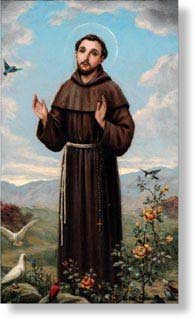
Francis was born rich but chose to embrace total poverty. He left the comfort, luxury, and security of his biological father’s house, clothed himself with a hermit’s tunic and cord, and lived with the lepers. He left everything to live like Jesus, the Incarnate Word, ‘the God who emptied himself, took the form of a slave and was born just like human beings.’ He literally and radically imitated and followed the footsteps of Jesus. He lived a life of extreme economic and spiritual poverty – a life of total dependence on God. Through a life of poverty, he learned Jesus’ ways. Experience (especially of poverty), which is very real and concrete, became Francis’ best teacher to know and learn to live Jesus’ ways. By being poor, he lived life the way the human Jesus did. He unceasingly preached and prayed. He used poetry, songs, drama, and symbols but above all these, his life was the excellent preaching and prayer that clearly witnessed to and revealed his message: Jesus. For Francis if Jesus was born helpless, dependent, and poor, there is no room for shame but an assurance of life controlled by meaning and intimate relationship with God, people, and the rest of all of creation.
Distinction and separation ceased to be for Francis. Everything- God, People, World – all creation fit into the circle of life that God designed out of love for us. Everything is interconnected and dependent on God who loved us and continues to love us. Through the historical man Jesus, God shows us not only how to be loved but also what is love and how to love. A love that embraces everything even the seemingly impossible, that is willfully and freely choosing to be poor in order to bring good out of evil, life out of death.
Jesus, the One who was born in a crib taking our entire humanity but sin, lived a poor life with people, was crucified and died, is God’s love who befriended the homeless, the oppressed, the sick, the sorrowing, the outcasts, and the sinners in an extremely loving fashion. Jesus is the justice of God who reached out to people, uplifted them and drew them closer to God with charming compassion. Jesus is the Beloved who embraced people and all of creation in an intimate and freeing relationship. Jesus is the poor, obedient, and faithful man who always lived in communion and total dependence with the One he called ‘Abba’. The same Jesus – human and poor Jesus, who swallowed and defeated death, is also the One Francis imitated, followed, and deeply loved.
Francis, convinced pf the immensity of God’s love, lived in poverty and identified himself with the poor. There is nothing to fear of be ashamed of. He has nothing but God who loves, is present and alive. He went around preaching and praying allowing people to touch him, engaging himself in profound conversation, befriending people, knowing people’s deepest being, sharing their sorrow, pains and desires. Poverty (not wealth, power, and status) brought Francis true freedom and joy. Poverty taught him the way of love and compassion that is capable of sorrow, of seeing goodness out of evil, of bringing hope in despair, of allowing everything to pass through him. Poverty made Francis an authentic joyful loving human.
Every time I think of Francis, I am reminded of what a song is. A song has rhythm, expresses and is full of varying emotions especially the deepest and genuine ones, appeals to the soul and depth and speaks both dark and radiant experiences. A song may be different from the other songs but they are all about human dynamism and people in their continuous becoming. A song is about life. Life is a song. G. Gutierrez says,”There is no Christian life without ‘songs’ to the Lord, without thanksgiving for God’s love, and without prayer. But these songs,” he continues,”are sung by persons living in particular historical situations, and these provides the framework within which they perceive God’s presence and also God’s absence.” However, Francis did not merely sing a song but lived it concretely in poverty where he experienced God’s presence and gave birth to it. His life is a song of endless praise to God, people, and nature. His life is a song of joyful prayer, thanksgiving, hope friendship, and love. Francis is a joyful song, a love song.
At present, we are living in a time and a world controlled by myths, full of violence and colored with lies, which continue to dehumanize and alienate people to their world and to themselves. Oppression and poverty escalate, ecocide becomes tragic at the worst, suffering severe, and death plagues. Events go beyond the imaginable. The dominant culture (i.e. The capitalist) does not oppress only lower culture but poison also the global world with the needs it persistently creates promoting a meaningful life measured by wealth and power (at other’s expense!). Indeed, we are called to be Francis of our time – persons capable of embracing the paradox of human living and becoming. We are faced with great challenge of making God’s presence alive in the suffering of our people, in the presence of death, violence, and hunger, and in abominable hopelessness. Our prayer and life commitment (especially as pastoral workers) are dared by these realities leaving us a narrow way in conquering them (prudently and with good). We ought to have the courage to leave our own personal comfort zones, overcome our fears and insecurities and love these people with the love of the cross, summoned to give a sensitive and appropriate response motivated by compassion and love. We are forever called to be songs for others who, like Francis, joyfully give witness and birth to Jesus Christ.
Every time the Cup is raised, let us remember the supreme love totally given to each of us in the humblest manner and take seriously the call for us to do the same.
References:
Gutierrez, G. We Drink From Our Own Wells. Quezon City: Claretian Publications,1984.
Handouts. The Life of Francis of Assisi… Stepping-Stones and Franciscan Spirituality. (Given
November 2001).
Personal Notes on Sr. M. Thomas and Ms. M. Altarejos’lecture on ‘Joy in Poverty’of Francis.
The Story We Live and Celebrate, Part II
A Personal Review and Reflection on Liturgy and Sacraments
What I see in all of this is the image of life as a ballet or dance and all that is involved in it: the dancers, the music, the emotions, the space, the environment, the interactions, the grace and harmony, the momentary silence, the reason for gathering and all. Everything-- everyone is interconnected and plays an important part in the beauty, joy, and meaning of the dance. This ballet is not exclusive for feast or for the rich alone but for all, rich and poor alike, and all kinds of situations and events in one’s life. Life can be a wonderful ballet not only in abundance but also even in poverty – in the scenario of a dark environment and sad music (caused by death, starvation, illness, oppression, and violence) -- because we continue dancing, sharing, singing, praying to God (adapted from L.J. Gonzales, The Artist of Nazareth 1996) believing that God embraces the whole of our human experience.
Jesus is the best creative artist who lived and lives fully in time and history. He met all kinds of people and addressed their physical, psychological, social, moral, and spiritual needs. He used his faculties – sight, touch, feeling, hearing, and taste – dreams, ideas, and resources in order to transform darkness into light, conquer evil and violence with good and love, bring life out of death, and create a world of harmonious dance and dancers. For example, Jesus, naturally creative out of love, left us his masterpiece of art, the sacraments, in order to introduce us into the cosmic ballet of life and make us dance to the rhythm of God’s love and peaceful joy. More so he was always in intimate and deep communion with God and God’s creative power of loving us to the end with a love that can and will never change (adapted from L.J. Gonzales, The Artist of Nazareth 1996). Jesus never leaving the bosom of the One who He called Abba (Father) sees the beauty of human beings and of the world and loves it to the end, gathering together our scattered stories, offering and uniting them to the one true Story.
We are constantly called and challenged to model upon him especially at this time and age of our history. We are called to ask and confront ourselves as individuals, group, people, and church with questions and realities especially the ones that we are afraid to dare to ask and be confronted with. We must faithfully review, reflect and look if our liturgy (or Christian celebration) moves towards healing and transformation; is a celebration of communion forming an inclusive community despite differences and gaps; radiates and mediates meaning and hope to the world that we witness to; and makes the ‘heart’ of the celebration shines through and penetrates everyone’s life.
The life of Jesus is a ballet ever graceful, beautiful, creative, powerful, hopeful, liberating, loving, human, and cosmic. This is the story that must live in us and we must extend and share to the world. Every time the bread and wine are raised we open our minds, hearts, and soul – our entire being – to remember, to honor, and to respond to the One who says, “Do this in memory of me.”
Disturbed, shaken, challenged, enriched, I realized that there is so much to unlearn, learn and be critically aware of. Despite the moment-to-moment falls, restlessness, and scatteredness of my personal experience of the world; I am very hopeful and eager for I strongly believe that we are Easter people and our life is a never-ending liturgy; that we live and celebrate a Story fixed forever; that our God is a God who conquers evil with good and brings life in death; and our symbol is the ‘cross’. We are all these… and this is the ‘rhythm that makes our life human.’
References:
Gonzales, L.J. The Artist of Nazareth. Mexico: Editorial Font S.A., 1996.
Guzie, T. The Sacramental Basics. NY: Paulist Press, 1981.
McKenna, M. Rites of Justice. NY: Orbis Books, 1997.
The Story We Live and Celebrate, Part I
Awakened by a gloomy morning and feeling of restlessness, I sat at the last row of Liturgy and Sacraments class hoping secretly that the session would be soon over. While Fr. Peter, my professor, seemed to be very busy writing something on the board, I curiously peeped over my seatmate’s heads and read a one-line statement in bold letters that said:
This is one of the topics Tad Guzie wrote and discussed in his book, The Sacramental Basics (1981).
I started to wonder what this could mean. “The rhythm that makes life human,” I repeatedly said to myself until I was totally captured by it—my attention, my intellect, my being. The way it was stated was very simple yet deep and striking. I knew then that I would never forget this line.
As I rethink of the statement now after a few months, it seemed old yet new. Memories of the Liturgy and Sacraments class flooded my mind – the words pregnant with meanings, the laughter, interactions, struggles, resistance and tensions, the creativity and flexibility of each one, the insights and expertise of my mentors. Each succeeded to make me feel the certain concreteness and uniqueness of a day from the other. This led me to an experience of learning, relearning, and unlearning; of review and reflection; of joy and struggles to understand; and of discovering new perspective and insights. These opposing categories made the class a meaningful and colorful journey. Let me now use the concept of the statement The Rhythm That Makes Life Human in the succeeding paragraphs.
It becomes clearer for me that we, more often than not, have the tendency to be trapped in the ordinariness and business of life day after day. We are caught up working for security and stability. Things and events get routinary, structured, and raw. The world for the majority becomes an enemy to wrestle with. The time becomes short. We succumb to fear, insecurity, and anger – unable to make sense of and come to grips with the fact that we are living in a symbolic and resurrection world full of vitality, activity, and meaning. It is in this world where every experience of dark and light, abundance and poverty, pain and comfort, sorrow and joy, as well as life and death count and is significant when lived.
We need to be fully aware or reminded that in our day-to-day experiences we neither hold stories of fairy tale nor fantasy but stories significant to ourselves, to others, to the world and the whole creation, to history, and to God. Stories which create, perpetuate, and touch life in its fullness. Our life is a story [of becoming] within and into that bigger story [which has already become]. We are real, living, walking stories… God’s masterpieces in time. Altogether we hold dearly the whole story and history of Jesus which enable us to go beyond every story to far bigger reality and live fully as humans. Or rather do we?
These stories cannot be mere backgrounds and products of our multiple experiences. They call for endless celebration where they are retold and remembered. A celebration, as my mentor Fr. Brendan Lovett emphasized in one of our classes, which makes us in touch of the newness of life, lifts us up, deepens the meaning of the stories that we bring and believe in as well as our day-to-day life. The celebration also brings us deeper and closer to the Ground of our being. Tad Guzie (1981) mentioned in his book that the retelling and remembering in turn help us to re-enter everyday lived experience with a sense of refreshment and a new sense of purpose. In simpler terms, it rescues us to the rigidity and monotony of life and allows us to walk with the One who shows us how to become by living fully and who says, “I am the Way, the Truth, and the Life.” Moreover our every celebration -- our liturgy, rituals, and sacraments -- (must) take on new meaning, creativity, and depth. Not only does it help us to celebrate but also to be rooted again and again to our tradition and original story in a newer and more meaningful way. As Tad Guzie beautifully puts it, it restores us to our proper relationship to history and history-making… reminds us that we are fully within history but that history is also within something else. Yes, when we live our experience, we should remember and celebrate them as individuals and one people who Jesus gathered and freed once and for all. As we are brought in communion to the Father, we are becoming in history of God, people, and creation open to God’s mercy and graces -- living everything, life as pure gift.
As McKenna in the book Rites of Justice (1997) have emphasized, it is important that in our liturgy everything becomes and is connected and form intimate relationships: the people or assembly, the leaders, their work, the words and actions, the space and environment (art, music, building, furnishings and objects, hospitality, appropriateness, etc..), the unity and harmony, the silence. The liturgy (must) capture the whole of human experience, nothing excluded, blending all our stories into the one Story we all honor and remember every celebration – that story of God, who makes all things new for us. McKenna added that the story sings of only the best for God and only the best for the poor, saying the way we work, spend money, and worship, as well as do justice and charity, is all one piece. Like Joseph in a Jewish story McKenna related, we work hard all week preparing and waiting for the Sunday celebration, and after the celebration off we go refreshed and renewed to the world.
Our celebration does not end here. We are Easter people and therefore must become human mediation of God’s presence and marvel for all. Like the journeyers of Emmaus we are called to bring and share the joy we experience and like what McKenna wrote to seep out into the world like heaven in bread, like balm for all pain and sorrow, like abiding peace with justice, like glory’s radiant reflection.
This is the reason why we are being sent at the end of the celebration. As McKenna says, “it is service, another way of washing feet, of bending before one another, of committing ourselves to the practice of the corporal works of mercy, of suffering with and for one another”. We must become what we celebrate, honor, and worship.
References:
Gonzales, L.J. The Artist of Nazareth. Mexico: Editorial Font S.A., 1996.
Guzie, T. The Sacramental Basics. NY: Paulist Press, 1981.
McKenna, M. Rites of Justice. NY: Orbis Books, 1997.
Angel Whispers
"Faith must have the kind of care you give a cherished plant. See to it that it is not just a latent seed, but a garden watered and tendered by constant prayer. Prayer is an act of faith in itself."
A DIALOGUE WITH MY CREATOR
My Creator, from the East I can now see the beam of the sun. It's impressiveness and radiant range all over. The blue, calm sea is now turning into a swaying orange scene. The green meadows are transforming into golden, shimmering outlook. From a peaceful and frigid world, it is changing into a busy one. Wake up, please my Creator. Ah! your eyelids start to move, I can witness existence on your face. Your hands begin to open. Then you grin and my heart jumps out of remarkable pleasure. "Good Morning" I greeted and without lingering for me to say another line He quickly replied "A satisfying day to you, my friend. It is still dawn and yet you called me. What do you want?" "May I have a day with you my Creator?" With a blink of an eye, I understood it was Yes.
"My I offer you something for breakfast?" " All I need is a cup of love for the orphans, a loaf of loving kindness for the needy, a slice of covenant and forgiveness for those who have done you wrong, a quantity of flowers for the altar and don't forget a respect of morning prayer." After breakfast, our dialogue began. I was almost a controller in our dialogue, Thus instead of a dialogue, perhaps it will be appropriately called a monologue. "You know, my Creator, I asked for this day when I can talk with you and vent out all the contents of my heart to you. I want you to know how much help you've given me through all those years. I can still clearly remember when I ask solution to my burdens. I tell you this wish before I go to bed then a day or two passed and when I opened my eyes, here comes what I wished. I run through our yard and catch dragonflies, pick flowers that attracts me, climb trees at times. I hurt myself at times, I stumbled but it was seldom for you were my guardian Angel.
Early school days, we were together. All what I see and observed introduced me to a new world. Yet condition was too difficult for on Sundays, I see you and I tell you how I spent the days, what I did. Time flies, it wings are so rapid that after elementary days follow high years then college times. Dear Creator, words are not enough to show you how thankful I am for all those gifts you've bestow me, for all the blessings you've given me and for all those warm-hearted and precious persons you've sent me in my existence. I've never forgotten to say this terse yet hearty prayer to you... I trust in Thee, my Lord. I adore Thee. I love Thee and I thank Thee for the life you give me. I offer all the things I'll do this day for you. Thus in all the ordinary actions I do, I make it extraordinary for it is for Someone who deserves the best of everything. Being at a new challenging life, my dear Creator, please always stay by my side and never leave me. Saturate my soul with your spirit and life. Permeate and own my whole being so utterly that all my life may only be a radiance of You. Shine through me, and be so in me that every soul I come in contact with, may feel Your presence in my soul. Without you I can do very little and practically nothing at all but with You my Creator, I can do great things and even impossible things for the matter. Let me know your command so that I can make your command for me to come true."
"It's evening now and You maybe want some rest or You may maybe hungry. What can I offer You?"
" I want to run around and take a glass of milk."
"Here is your glass of milk. I did it specially for you."
"Thank you. My glass of milk contains various of ingredients. It has a zip of modesty, purity, generosity,genuineness, honesty...Take it so that those attributes will be with you for always. This universe will be a better place to breathe in when love is visible. Distribute it to everyone for in them you'll see me. In a clean heart I'll stay, just call me and enunciate the sincere need for Me and I'll be there. Don't forget to pray always. Till our next dialogue.
[my cry]
I am living in a circle of misfortunes,
my bones are crushed and I am down to my knees
with dirt on my face and wounds all over my feet.
Where are you God?
I cry out to you Lord, wherever you are.
Hear my plead
Hear my sorrows
Hear my cry
My cry for your light
My cry for your warmth
My cry for your love
It is you who have the power
to wash away the darkness
in my life.
And it is only you who can resurrect me from my grave.
Touch me now.
Hear me now.
Renew me now.
I surrender.
Angel Whispers
“To faithfully abide by God’s laws is never an easy task. A person who wants to serve the Lord will be disciplined and molded by the hands of God. He who follows Him will face trials and difficult battles. But remember this, although he will be wounded as much as a wounded soldier in the greatest battle of the earth, he will not perish. Remain steadfast and pure of heart. Trust in the Lord.”
RENDEVOUZ WITH GOD
Oh! Look at the flowers
blooming in Abundance
their rainbow colors
heightened to perfection
by the golden stream of light.
Look at the butterflies,
the bees dancing
an excited jubilation
to the colorful chirping of birds
Listen to their chorus manifesting
each their own individualities
a soul is in rapture,
soaring free from the tangles of the doomed world.
Shh! Listen to the caressing breeze among the greenery...
"God loves! God loves! God loves!"
Hey, the tricking brook playing
Among the rocks is answering fervently "Amen! I agree! Praise him!
Hallelujah! Sigh! what a marvelous panorama to behold!
Hmm! what's that? my nose tingles with the smell of sweetness,
freshness and life...
intoxicating, elating!
Oh God! It's wonderful!
the place is bursting with joy, praise, and thanksgiving
for the love and care of fulfillment a picture of love
and sign most dear to the heart.
I pray, dear Lord,
that I may be ever more praising
and thanksgiving for your love
and that I may love you better as the days go by. Amen!
“For the love of Christ constraineth in us... and that He died for all, that they which live should not henceforth live unto themselves, but unto Him which died for them and rose again" (11 Corinthians 14-15)
GOD'S INSTRUMENT OF LOVE
We should be people of prayer... Why? Because human beings need to be in constant touch with GOD. There are times and places when formal prayers like the liturgy are most important. Even so, the rest of our prayer life should consist of informal, spontaneous, from-the-heart conversation with GOD. "GOD is the health of the soul." By listening and praying, I can get to the root of the problem in every situation. I found that either the emotional or spiritual health of the person I am counseling improves when I listen and pray.
Genuine encounter with CHRIST is a realistic awareness of self so infinite in contrast with the infinity of GOD. GOD dealt with me not because I am gifted, holy or worthy but because "GOD loves me and wants me to extend His love, His gospel to as many people as possible during my life on earth. There are many ways to the LORD. The possibility of being filled with the Spirit, manifesting His manifold gifts and fruits even though one is not a member of the Christian renewal or any other spiritual movement.
What then is sanctity? I believe that it is "doing the best job we can of living the Christian life with the talent, time, and energy GOD has given us." Let us deepen our faith more as true Christians, as GOD gives us the grace and strength we need. His love for us is endless, so let us not ignore his calling. Let us embrace Him and help Him and make a better world. It is truly unfair that until this time He is still suffering from human frailties despite the love that He is giving us – His divine love is beyond compare.
Looking back to what He had suffered, THE WAY OF THE CROSS, is never a pleasant experience. It is a long and painful walk and it requires a lot of courage, sacrifice and self-giving. It is a way of life. Christ walked up to Calvary to die on the cross and carried all the pains with patience and resignation to save us from our sin. GREAT ACT OF LOVE!
His loving Mother Virgin Mary who suffered from great sorrow filled her heart when she received the lifeless body of Her Divine Son into Her arms... What anguish? What a way to lose one's only son? The sword of death penetrated the heart of the MOTHER of CHRIST. Silently and intensely, she suffered all the agonies of her son. Mary, our beloved MOTHER and HIS only begotten Son suffered an excruciating pain. Their suffering is a tremendous act of compassion and love. It teaches us to comfort those who are grieving, and to give them consolation of FAITH.
GOD gives us the grace to will and to do what pleases Him. He gives us the grace to believe and obey Him day by day as He transforms us from one degree of glory to the next. His grace is powerful and it gives us the power to make a vigorous response. Let us all saturate our being with love, to be "in love" with GOD. Mold a heart to love and obtain a heart open and ever wider to love… a man more able to say no to self and yes to GOD, to shower himself out with prayer, to render service for his brethren and for the whole world.
God is engaging us to share in His own love, to partake in the love that is being poured out between the Father and the Son and the Holy Spirit. We should let the love that is outpouring between the Father and the Son and the Holy Spirit catch us up. We should let it cleanse us, form us, and manifest itself through us. If we grow in sacredness, we will be less likely to take offense and more likely be the one to bridge the gap when there is tension and pressure in relationships. We will be less likely to fall into conflict and rivalry. We will be able to hang in there… loving when things get complicated. Let us all become more capable of acting out compassion when we notice opportunities for doing good even if it is not strictly our responsibility.
A great gift has been given to us - the very life of GOD. We are not to be passive vessels of this gift but be willing subjects to receive it, stimulate it, value it, act on it, move on in the power of GOD. GOD is holy. GOD is love. As we grow in sacredness, we are grow to love for GOD and our fellow human beings.
"Love is not jealous or boastful; it is not arrogant or rude. Love does not insist on its own way; it is not irritable or resentful; it does not rejoice at wrong, but rejoices in the right. Love bears all things, believes all things, hopes all things, endures all things."
“Lord, make me an instrument of your peace, where there is hatred, let me sow love, where there is injury, pardon, where there is doubt, faith there is despair, hope, where there is darkness, light, where there is sadness, joy. O divine master, grant that I may not so much seek to consoled as to console, to be understood as to understand, to be loved as to love, for it is in giving that we receive, It is in pardoning that we are pardoned, it is in dying that we are born to eternal life.”
Love never ends - if you live in love and with love life is wonderful and meaningful. So, why not live and be an instrument of GOD'S love?
A Time with God
What is Prayer? It is our way of communicating to God. It is in prayer that we can express our gratitude to our Provider -- even our hopes and desires. Nneka presents Prayer 101 posted at Spirituality Applied to Life. Submit your blog article to the next edition of the Spiritual Growth Carnival using our carnival submission form. Past posts and future hosts can be found on our blog carnival index page. Technorati tags:
In prayer, we begin to be in touch with the Higher Being. In silence, we begin to cast our cares on God and begin to contemplate. In contemplation, we begin to listen and be in touch with our inner selves. Karen Lynch presents an article on listening and trusting your own wisdom. Read Intuitions and Wisdom posted at Live The Power.
Would you like to spend time for meditation but are you too busy to sit down and keep still? Know the special benefits and other interesting information about walking meditation by Michelle Wood in her great article entitled Walking Meditation posted at Living Stress-Free ~ Naturally!. How about a simple meditative technique by Chris? Read his article entitled Cultivating Happiness with the Secret Smile posted at Martial Development.
Spending time for prayer can be a big task for some. But the fruits of prayer are great. It is a worthwhile activity that we should all make time for.
When God becomes a part of your activities, He will keep on sending us signs and symbols for us to continue trusting in Him. Read a remarkable experience by Raymond David Salas in his artcle entitled Pennies From Heaven posted at ZenChill.com - Power Tools for Mind, Body, and Soul.
OTHER POSTS
Kavit Haria presents Calmness admist the storm posted at Kavit Haria.
Laura Young presents More on Life Purpose: Sometimes You Leave Clues posted at Dragon Slayer's Guide to Life.
Miguel Trujillo presents Invincible Happiness and Look for What You Want to Find posted at Think Happy Thoughts Happiness Blog.
Do you want to break a bad habit? do you wish to improve you life? Erich presents 10 Days to a Better Life posted at LifeTraining - Online.
David Maister presents Islamic Saying posted at Passion, People and Principles.
***************************************
spiritual growth carnival, blog carnival
Equations of Spiritual Growth
Welcome to the first edition of the
Spiritual Growth Carnival!
There is no single set of rules -- much more no easy way to attain a higher level of consciousness. In this world, the situations in our lives become the means to mold us -- prepare us for something bigger than ourselves. In our path to spiritual growth, we should learn to be in touch with ourselves and communicate with our Inner Being. When we have successfully done this we acquire the gift of discernment, wisdom, compassion, peace, and joy.
We all know that our experiences and interpretations about spiritual growth vary and so for the first edition of the Spiritual Growth Carnival, let us present to you the different equations of spiritual growth.
1. Self - (self) = emptying the self
Spiritual growth may begin when one learns how to empty the self. In order to empty oneself, a person should accept that he/she is nothing without the Higher Self or Being. In Raymond David Salas' article called The Power of Surrender, learn simple "Spiritual Tools" in order for you to experience the power of surrender. You can find this article at ZenChill.com - Power Tools for Mind, Body, and Soul.
Emptying oneself is not a one-time event. It should be practiced in one's everyday life to continue to receive it's fruits. It is not easy either. Meditation is one way to free yourselves from the busy world we live in -- but remember, meditation demands patience and discipline. In a short article by Darren Hayhurst entitled The Minds Focus posted at Darren Hayhurst.com, learn a simple way to meditate. Another way to meditate is presented by Man Anonymous in a simple article entitled About Meditation posted at Blog of Mr. Anonymous.
2. Self - (hurts + vices + attachments) = freeing the self
To attain spiritual growth, we must learn to let go of our bondages. Are you willing to let go? Dr. Hal presents North Star Mental Fitness Blog: Christmas posted at North Star Mental Fitness Blog.
For many centuries, the term "church" has been widely misunderstood. Unfortunately until now, a church is perceived by many simply as a building or place of worship. But it is not only that -- the Church is the people of God communing in faith and charity. When we serve our God through serving others, we begin to learn how to sacrifice and free ourselves from being attached to worldly desires. Although we may not be aware of it, our hurts also become healed and we become renewed. Nevertheless, no matter how beautiful the concept of the Church is, becoming a member of one is not a panacea. We will still encounter challenges that will continue to mold us and make ourselves wholly. Read KWiz's personal experience in the article entitled, Can A Christian Grow Spiritually Without The Church? posted at WOMEN WALKING IN WISDOM'S FOOTSTEPS™.
3. (Self - expectations) + (openness + acceptance) = purpose and meaningRead Ayesha Ashley's personal experience and learn how she discovered her own gift in her article Find YOUR gift. posted at Find YOUR gift.
4. Self - (doubts) + (trust + discipline + vision) = True Teacher
If before, personal growth happens through time and that the tradition of healing is passed on from one generation to another, nowadays personal and healing skills development can come with a cost. Maria Yu presents Cost of Personal Development and Spiritual Growth posted at art-life-spirit. If personal growth and healing seminars are too costly, should we let these be a hindrance towards our path to spiritual growth?
For those who would like to try out reiki, tc presents Choosing a reiki teacher posted at reikiblogger. The blind cannot lead the blind so this is a must read if you want to make your future classes worthwhile.
How about kundalini? JJ Semple presents My Meeting with Gopi Krishna posted at k~Blog.
On the other hand, if you can't afford to enroll for a course on improving your personal life, why not read Peri-Coeurtney-Enkin's article called Living Big in Love and Work - Do What Deliberate Creators Do posted at JT Chandler. What's great about it is that it's simple, effective, and free!
Unlock the master within you... here's another great post entitled Channeling Inspiration by Lorenzo posted at RealitySeeds.
5. Self - ignorance= empowerment
Mark McManus reminds us that "we are what we think". Read The Purpose Of Circumstance and How To Take Control posted at Build Your Life To Order (tm) and let yourself be empowered.
What does faith have to do with everything in your life? Alan presents The power of Faith posted at Made to Be Great.
When you are free of your bondages, you begin to become empowered. A word of caution though, spiritual highness doesn't last long. After a moment of feeling 'connected', there will be a moment of 'non-movement'. It is when some people feel as if nothing is happening in their lives or that they have stopped growing spiritually. During this moment, stay strong and hold on to you faith, because when the right time comes and you are prepared, an 'awakening' will occur in your life. Read John Hill's thoughts in the article entitled Becoming Aware Of The Real World posted at Universe Of Success.
OTHER POSTS
Ken presents the guiding principles from a Japanese samurai known as Miyamoto Musashi. Read his article entitled, Lessons Learned from the Greatest Samurai, Part I posted at Ken Nubo, PUA extraordinaire and ranting buddhist.
As one becomes more mature, his/her perception is widened. Scott Lee presents Cycles of Clarity posted at Dirty Mechanism. When events in your life seem to go wrong, just trust the path that leads you to a greater understanding of things.
Can we be happier? Yes! How? Miguel presents How to Be Happier posted at Think Happy Thoughts Happiness Blog. Also, Barbra Sundquist presents Joy Is Not the Same as Happiness posted at WelcomeJoy.com.
Inner joy also comes from being thankful for the blessings that we receive day by day. Alan presents Attitude of Gratitude posted at Made to Be Great.
We are all treading the path to spiritual growth -- only in different levels. To know whether you have already gone far is not essential. What's more important is that, despite the noise around you -- you are able to keep still and tranquil -- you are able to maintain the feeling of oneness with a Higher Being or Self, with Nature, and with the creatures around us.Wishing you a blessed journey! We hope you have enjoyed this month's edition of the Spiritual Growth Carnival and that bloggers will continue to share with us their knowledge, thoughts, and experiences. Thank you very much.
***************************************
Submit your blog article to the next edition of the Spiritual Growth Carnival using our carnival submission form. Past posts and future hosts can be found on our blog carnival index page.
Technorati tags:
spiritual growth carnival, blog carnival
Understanding Salvation 2: A Commentary
A commentary on J. Aagard's article "Exclusiveness and Inclusiveness Examined From the Point of View of Mission Theology" (Aarhus, Denmark 1999 pp.1-10).
The issue of 'salvation and who has it' has existed for so long and is still a problem today. Misconception of what the term salvation authentically might mean became a robust lie and a flaw that created a profound split between two positions we now call 'exclusivists' and 'inclusivists.' For centuries, the issue of who holds the truth became a popular wafare.
The fact that the consequences of this issue in history have become oppressive and unjust must sadden, pain and challenge us. After reading the argument that Aagard brought to the fore in his article, I am more convinced that we are faced with an enormous task that must be taken seriously. It is a task that neccessitates our careful rethinking, understanding and study. More imortantly, it should take into account not only the piece and parcel of the story but also the whole of its emergence and becoming in history.
If God allows the rain to fall and the sun to shine to the whole of creation, so is salvation. The God revealed to us by Jesus is a God of history who reaches to people and all creation. When we look at the Gospel, Jesus' becoming, life and ministry in history reveal a God who wants to be one with all of us. However, the truth and the message of the Bible [particularly the Gospel] have suffered much injustice for being understood and interpreted to suffice prejudices and use as a measure to gain power and superiority. Reading and interpreting the Bible that way no longer make known the God whom Jesus revealed to us.
We must go back to the core of our faith and salvation history. We must never forget that there is no such thing as timeless truth. The truth we believe, the faith we profess, the life we live has a history, a context and we must not abolish them or we shall become persons without roots and foundation who bring only our own messages and self-interests. When we read the Bible, we must not neglect the context it came from and the truth that everything in it is a story of faith and freedom which includes ALL - all peoples, all nations, all creation.
Aagard's idea which says,"There is salvation outside the church but not outside the truth." captured my attention. Indeed, our faith regardless of our own particular religious and cultural backgrounds are imbued with one and the same truth. The truth of the Ultimate Reality which we Christians call God. I believe that the Truth who lives us and how we authentically live as human beings determine how we will be saved.
True mission therefore, is not converting people to what we believe and make them follow our own particular expression of faith. True mission "consists in accepting people, in neighbourly existence, as co-workers in peace and justice." It is guiding people who desire to know and live the truth in and through a multitude of contexts and expressions based on and springing from their own reality. True mission liberates rather than discriminate or oppress the other. It calls for repentance and conversion in a very respectful and genuine fashion of communication to all of humanity. It is like Jesus who opened wide his arms in a charming and powerful embrace of the crucified world to bring life and lovingly lift it up to Himself and to the God Who saves.
A World of Prayer
by Merlin
"Ask and it shall be given to you; seek, and you shall find; knock, and it shall be opened to you."
We live in a fast, changing world, yet we must realize that we have to stop awhile and think of where we are heading for. How often do we hear complaints? Unnumbered, millions of problems and worries are faced by the present generation of men and women. You will more likely see people wearing a frown or tear - stained eyes than one with a smile upon beaming face. People are too preoccupied thinking of solutions to these.
Their intelligent minds have come up with impressive and great ideas, but all to no avail. Day in and day out, there will be mountains and mountains of cares to climb. People of the world, can you think of something to wind down your burden which is heavier than this world in which you live? I agree with you when you say you never let a single second pass without a possible answer to your long list of misfortunes. Are you not forgetting? Despite all these, you seem to have left something out. You might have missed the best solution of them all.
Prayer is the best instrument every man should possess for himself in this highly-challenging world. Ask light by prayer on all problems, big and small, that arise with the sun and never quite disappear from earth's day. Never ask solutions, but demand light by which to make them. You'll probably tell me that you do pray. But do you really? Can you honestly say that you really communicate with God? Have you really ever tried to reach His heart and poured out your heart's contents? Have you ever offered Him what you ought to give? Do you thanked Him for the past favors not granted? Have you? Or did you just make a hasty sign of the cross followed closely by an enumeration of your endless petitions, of the things that you need?
What is prayer? How must we pray?
Firstly, let us consider when do we pray? as mentioned earlier prayer is communication. When we want to talk with a friend, do we wait for a certain time as 5 o'clock in the afternoon? When we are so happy about a particular event or a surprise given to us, do we wait for another hour? No. Prayer is exactly like that. Just as God is our Father who is more than willing and patiently listen to His children, we don't have to wait for any hour to pray. We can pray to Him anytime. Let us never be mindful that when we are in need of someone to run to He is always there, ever ready to welcome us. If you are in search of someone to share our joy and our experiences, He is also there, very eager to listen to us.
Secondly, let us develop perseverance and constancy in praying. When we ask favors, we kneel down for a number of hours or even days spent in prayerful effort. When it is not granted and our prayers remain unanswered, we cease to pray. This is a very wrong attitude. Our Father is so loving, He'll grant our wish, but we have to exert effort at times and we must be persevering so that our pleas will be heard.
How do we pray? In what gentility must we ask from God? For effective prayer, faith is necessary. They say that " faith can move mountains". Faith come easily if you remember that there is no greater chasm between the worlds. A prayer of faith attached with confidence is the best prayer. Do not try to connect with someone or something far off dismally removed from your sphere. Realize the presence of God; His omnipresence, His omnipotence. That spark of His presence inside you must, in prayer, be united to the great light which you are too blindly flesh to see. Be at peace about his decisions. Be at peace in the Great Consciousness by writing your will with the wisdom of the divine will which is comprehensible to you. Faith and trust in God must reign in us so that we may believe in him and in his mercy to make our petitions come true. Fear nothing; learn to recognize the voice. Have faith and trust.
We must ask God for good things, we must request Him for his heavenly kingdom, for the welfare of others and finally for our own good, too. Yes, we can ask from God anything provided it is in conformity with the Good and Truth. What does God want us to ask? First, is for His kingdom here on earth. Let us all seek the glory of God and establish a Christian kingdom here on earth. Before seeking for anything here on earth, we must seek God's kingdom first. In so doing, searching for His kingdom will lead us to possess everything of value in life here on earth. God, being so loving and so understanding, says that we have to ask for the things we need here on earth by all means. Such necessities, mind you, must enable us to be instruments in spreading God's kingdom. [Then let us all ask for forgiveness]. Before we ask favors, let us try to recall our mistakes and shortcomings which weaken our relationship with God. Let us all ask, too for graces so that we may live in aegis always. Temptation bound in this life so we must ceaselessly call on God's aid to win over them.
"Through Christ our Lord" is the phrase we must never forget to mention in our prayers, let us bear in mind at all times that, "no one comes to the Father except through me" -- these are Christ's words. We should always remember the God made-man who was sent to redeem us because of God's great love for us. In order to reach our Father's mercy, we must always invoke the sacred and powerful name of Jesus Christ. Didn't He say "anything that you ask the Father in my name, He will give you"?
This is what true prayer should be and how we ought to pray. If we are seeking for peace and happiness on earth, we must live in a world of prayer. There is in each of us a need for someone extra-human, to believe in someone who is more than human, responsible for eveything in the cosmos. From the movement of the celestial bodies to the activity of the minutest unicellular form of life. This need can only be filled in by God and faith. And is an imperative part of this relation. Prayer must always be present in our life in this world. Prayer is rather the raising of the heart into the presence of God anytime of day. It is the praise and joy exuded as flower sends forth its perfume. It is a warmth radiated as the sun sends forth the healing ray. It is a wind that wandereth where it is listeth, and a fresheth of clear water for the soul that thirsts. Prayer is the best treasure that we have here on earth. Let us not forget the saying: " What does it profit a man if he gains the world, but suffers the lose of his own souls?"
A Way to Meet God
The world's fast and massive changes are irrepressible that places everyone in a state of endless battles in the arena of a hectic and topsy-turvy market place. People whether rich or poor, young or old, are governed by their economic needs here and now and in the future. Their major interest is starting to be highly directed to what the world offers and can offers anew. And we are one of them. We become "worry and are troubled of many things" [Luke 10:21] that we gradually and eventually miss the better part of our life. We therefore, can't help but experience a value and spiritual crisis amidst the powerful, enormous, and complex wave of life. The rapid change and the influence of the global culture truly affect us as well as the rest of humanity in the world. This reality places us in the situation where God's presence is very subtle, where His seeming absence widens the vaccuum of emptiness that the world creates. The challenge is very great. How can we become Martha who "was busy with all the serving" [Luke 10:40a] and at the same time Mary who "sat down at the Lord's feet to listen to His words" [Luke 10:39]. How can we grow, nurture, and deepen out spiritual life in the midst of our copious and ever-increasing concerns? How can we encounter God in the world so full of activity and vitality?
This article invites you to discover and delve with me the why and how, in the middles of the many challenges and enticement of the world, do and can we encounter God through study.
Nowadays there still exists the mistaken notion of study and what it can do to us. Customarily, it is understood as a stepping stone and passport to future success. It oftentimes is seen as a tedious and arduous work that needs muscular effort and consumes a great deal of energy.1 But I am sure that quite a number of personages would disagree with it (Timothy Radcliffe, Simone Weil, and many others are significant mentioning). I would like to say that study is worth a struggle, an endeavor, sweat and tears. Why? It is because a [life of study] is not only a milieu of new learning and discovery but also where a gradual and idiosyncratic encounter with God can happen. Study is an eventful engagement but it is above all pausing, thinking, dialoging, and contemplating. It is an ongoing activity that opens our eyes to a wider and deeper horizon of reality, knowledge, and the authenticity of life. It is an incessant journey of joy, of sharing, and encounter always new.
Study is a pilgrimage. We are pilgrims and I would like to compare us as to the pilgrims of Emmaus. The two men began their journey wondering and searching for teh truth (the truth about the news of Jesus' resurrection). And when they have finally known the truth, they went back to Jerusalem at the very same day. They did not even stay and rest there for the night. This happens in our study. We wonder, we question, we want to discover and know, thus we seek for the answer. Once we already know the answer, we are still unsatisfied that we never cease our search and go further. Study is a continuous search and we would never come to its finality because every discovery and new learning of truth liberates us to continue the journey, to search for more -- for a bigger and new truth.2 Our study guarantees that there will always be something more that is new and relevant. Nevertheless, in our studying we, our intelligence particularly, are always moved and led by desire3 that we keep questioning, searching and moving unsatisfied of the present finding and desiring for more.
Study is an act of constant dialogue. The two men on their way to Emmaus talked and shared their wonder with each other. They did not keep their questions to themselves but brought it out in the open. This is study. In our pilgrimage, we dialogue not all alone with ourselves but we "enter into a conversation with ones brothers and sisters and with other human beings" not to determine who is the cleverest but to understand and know the truth that liberates.4 Study is a search for truth together and we cannot do it alone. It is therefore important to argue, debate and struggle to understand because it will not only help us find the answers to our questions but will transform us as well. Our dialog and studying together will enlighten us and give us new insights and wider understanding.5 Above all, like the two men on the road to Emmaus, we are bound to meet God because the "Creator is more intimately close to us than being could be, since He is the ever present source of our being"6 and compared to other occupations "studies are nearer to God because of the attention which is their soul."7 The truth that we await and search for comes to us and teaches us. "While they were talking and wondering, Jesus came up and walked with them." [Luke 24:14] Our study is not merely a search for truth but a dialogue with the truth itself. Who would unveil the cover that held our eyes and from whom we will learn from but from the one who says, "learn from me" [Matthew 12:29] and "I am the Truth"? [John 14:6]
At this point I would like to compare what happens to our study to a new pair of eyeglasses (given to us as a gift) in change of the old one and upon wearing it, how amazed we are to see more clearly. Not only that, because of our unceasing journey and determined struggle we develop the faculty of our attention making us persons with certain focus, keen eyes, intense sensitivity, depth, and dedeper spirituality that we are able to receive, grasp and savor the truth.8 "Then their eyes were opened, and they recognized him...And they said to each other, "Were not our hearts filled with ardent yearning when he was talking to us on the road and explaining the Scriptures?" [Luke 24:31a, 32] Our dialogue, our studying together becomes a moment of truth that opens wide and clearly our held eyes and "liberate us from the narrow confines of my experience and my prejudices and open up the wide open spaces of a truth which no one can master."9 Radcliffe again says in his letter to the Order, "Study can never be just the training of the mind; it is the transformation of the human heart."10 "They are modes of religious expression." We grow in our spirituality, we understand and appreciate our experience and we deepen the quality of our prayer.11 The development of our intellect and the increase of our knowledge help us to understand matters about God. In the light of faith we recognize and encounter God who is present, active and living in us and around us. "For an adolescent, capable of grasping this truth above all others, studies could have their fullest spiritual effect, quite apart from any particular religious belief."12 It may take time but our faith, our desire, our awareness of being mendicants before God will give us confidence and make us humble to wait upon the truth. Weil says that,"there is a special way of waiting upon truth"13 and we can be sure that God will make himself known to us.
How much joy there is in our hearts at the prospect of encountering God! How much joy the pilgrims of emmaus felt when they recognized Jesus that "they immediately set out and returned to Jerusalem." [Luke 24: 33a] Their stillness and sadness run off them and they become truly alive once again. Radiant, exuberant and overflowing with joy they shared the good news to the Eleven saying, "Yes, it is true, the LOrd is risen! He has appeared to Simon!" [Luke24: 34b] Study then is a moment of joy and sharing. What more an encounter with God can do to us but experience a surge of immense joy that tastes just right to our longing, wondering and busy heart? According to Radcliffe, "To study should be simply part of the joy of being fully alive. The truth is the air that we are made to breathe."14 And the moment we finally receive the truth as a gift we cannot help but share it to others. Renewed, truly alive and replete with extreme desire we shall leave our jar full of our own prejudices, biases, preoccupation and ourselves and ran to the marketplace shouting to the people in great joy "come and see a man who told me everything I did! Could he not be the christ?" [John4: 29]
We shall continue our journey with a new and clearer vision, with joy, with and in the company of our neighbors towards a more far-reaching and transforming encounter with God that would make a prolific human-spiritual growth possible for us in the realm of this progressing and changing world. It is study that would be our surety and vehicle. With God's grace, we will continue our journey confident and wholly convinced that "Academic work is one of those fields containing a pearl so precious that it is worth while to sell all our possessions, keeping nothing for ourselves, in order to be able to acquire it."15